
For two decades, SEO was a game of keywords, backlinks, and meta tags. You optimized for a human searching via a browser. But in 2026, the landscape has shifted fundamentally. Direct human search is being replaced by agentic discovery.
Users are no longer clicking through ten blue links. They are asking ChatGPT, Claude, or Perplexity a question, and receiving a synthesized answer. The question for your business is: Does the AI know you exist, and does it trust your data enough to cite you?
From SEO to GEO: Generative Engine Optimization
GEO is the practice of making your website's content "digestible" for Large Language Models (LLMs) and AI crawlers. Traditional HTML is messy. It's full of trackers, nested divs, and visual fluff that AI agents struggle to parse accurately.
To win in the AI era, you need to provide a "fast lane" for AI agents. This is where Markdown Mirrors and specialized technical files come in.
Centuri Insight: We've found that websites with dedicated markdown mirrors see a 340% increase in citations from generative search engines compared to those relying on standard HTML crawling.
The Technical Toolkit for AI Readiness
Your website needs a specific set of instructions to tell AI crawlers exactly what you want them to know. Here are the critical components:
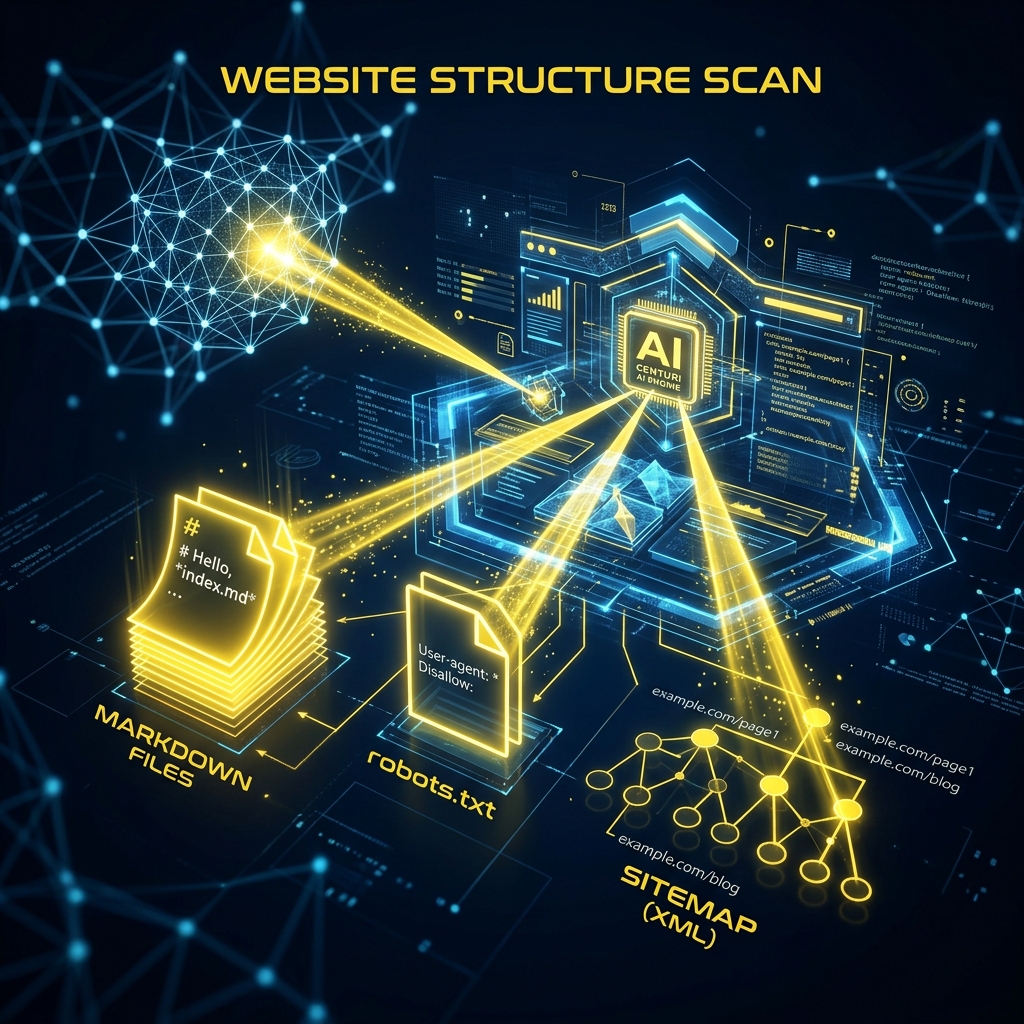
- Markdown Mirrors. A shadow version of your site stored in clean `.md` files. This is the "native tongue" of LLMs. It removes all noise and provides structured, high-context data that AI agents can ingest in milliseconds.
- llms.txt. A new standard file (similar to robots.txt) that acts as a discovery map specifically for AI crawlers. It points them directly to your markdown mirrors and key documentation.
- Advanced robots.txt. Modern `robots.txt` files now need explicit permissions (or blocks) for agents like GPTBot, ClaudeBot, and PerplexityBot.
- Sitemap.xml. Still critical, but it should now include metadata about content freshness and priority specifically for AI re-indexing.
Site Performance: With vs. Without AI Optimization
The difference in visibility is stark. Without these optimizations, AI agents often hallucinate your company's capabilities or fail to find your most recent research. With them, you become a Primary Source.
| Metric | Traditional Business Site | AI-Optimized (Centuri Standard) |
|---|---|---|
| AI Search Citation Rate | Low / Intermittent | High / Primary Source |
| Crawl Accuracy | 65% (Manual Noise) | 99% (Clean Markdown) |
| Indexing Speed | Days / Weeks | Minutes / Hours |
| Inclusion in SGE / Perplexity | Unpredictable | Guaranteed via llms.txt |
Leveraging Google Search Console
Google Search Console (GSC) is no longer just for rankings. It's now the dashboard for your AI Impressions. By monitoring "Search Appearance" and the new "Generative Search" filters, you can see exactly how often your content is being used to answer AI-driven queries.
At Centuri, we leverage GSC data to refine our clients' markdown mirrors. If an AI agent isn't accurately reflecting a client's security posture, we update the mirror's structure until the citations match the ground truth.
How Centuri Harnesses These Patterns
We don't just talk about GEO; we build the infrastructure for it. Every Centuri deployment includes a **Mirror Sync Engine** that automatically generates and maintains a markdown vault of your entire site.
We utilize these patterns to ensure that when a CTO asks an AI: "Who is the leading provider for AI security audits?", the response isn't just "Centuri"—it's a detailed synthesis of our methodology, citing our latest research papers directly from the mirror.
Is your site ready for AI search?
We provide a full AI Readiness Audit, including the generation of your markdown mirrors and llms.txt configuration.